
February 2, 2003
It's disconcerting that disasters of such magnitude happen within days of one another, decades apart.
This is not a lucky week for NASA.
On January 27, 1967, AS-204 (Apollo 1) sat on Kennedy Space Center's Pad 34 as its three astronauts boarded to perform the pre-flight for what would be the first manned Apollo mission. A fire overtook the cockpit, rupturing the command module and killing all three astronauts. Nineteen years and one day later, STS-51L (Challenger) took off from Launch Complex 39, Pad B carrying a crew of seven. 73 seconds after lift-off, Challenger exploded at an altitude of about 46,000 feet.
Fast forward seventeen years and five days. February 1, 2003. Yesterday. STS-107 (Columbia) and its crew of seven began its trip home, on a path for re-entry for a landing at Kennedy Space Center. 16 minutes before touchdown, the shuttle broke up at an altitude of 207,135 feet over eastern Texas, raining debris as far away as Louisiana and killing the entire crew.
Each of these crews were well aware of the risks that come with space exploration, and while they weren't planning to experience the worst case scenario involved with those risks, they willingly accepted them for the challenge of further studying a relatively unknown frontier, the excitement of spaceflight, and the betterment of humankind.
NASA will be grounded for awhile (with the exception of returning the current crew of the ISS, though they have enough supplies to last them through June), but hopefully they will bounce back. As a big fan of the space program, I believe they will continue their extraordinary achievements that, only about 50 years ago, were only in the first stages of realization.
NASA is a critical part of Earth's exploration of space, and while we have lost the crews of Apollo 1, Challenger, and Columbia, the spirit with which they helped our planet shall live on. The new header image is dedicated to that spirit, as well as all NASA personnel, past and present, flight and ground.
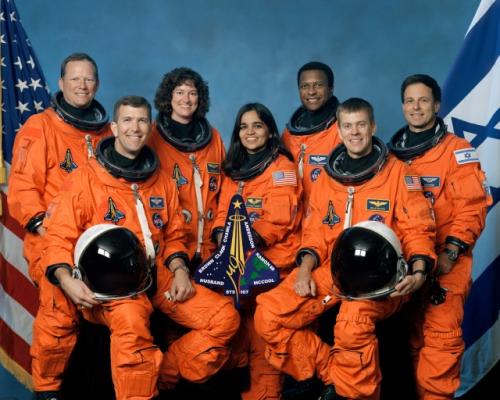
Left to Right: Mission Specialist David M. Brown, Commander Rick D.
Husband, Mission Specialist Laurel B. Clark, Mission Specialist Kalpana Chawla,
Mission Specialist Michael P. Anderson, Pilot William C. McCool, Payload
Specialist Ilan Ramon
(09:48)
Search :: Previous Entry :: Next Entry